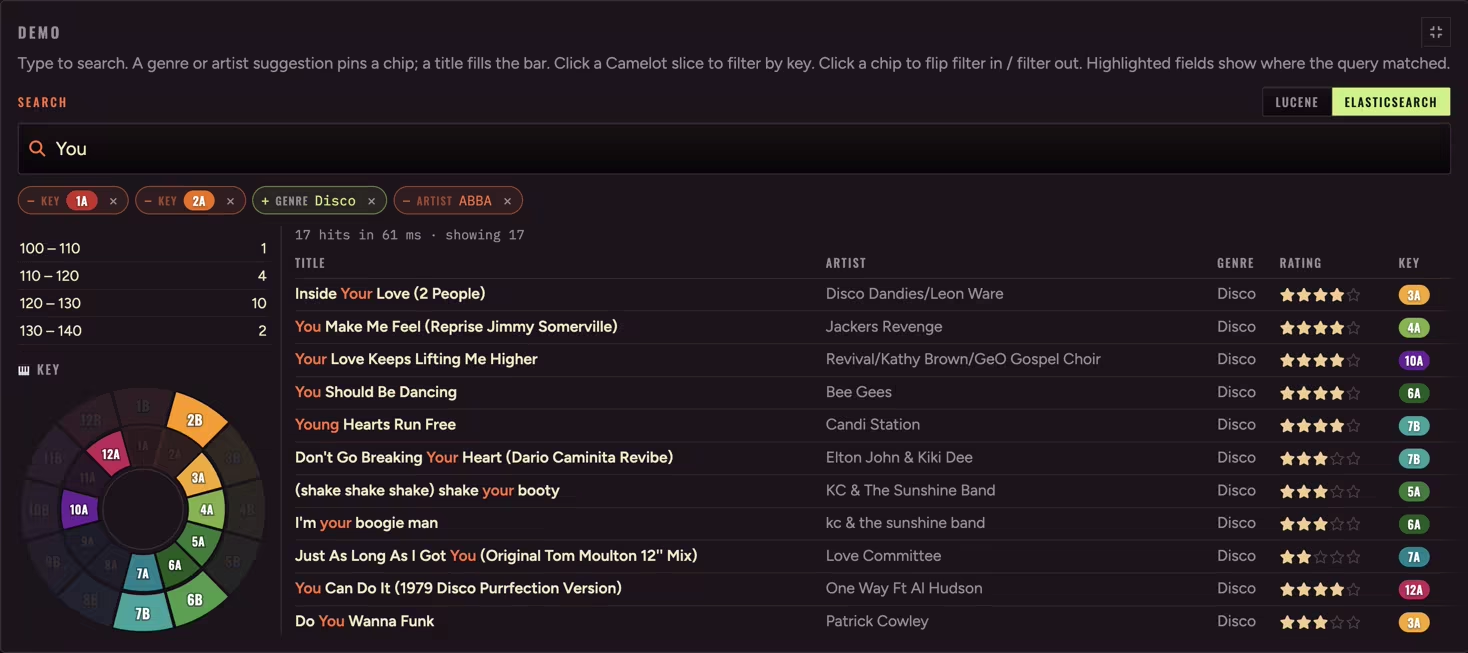


We mapped beans, owned a writer, typed Bob, filtered Club, counted facets,
suggested prefixes, and painted hits. That was Lucene next to the JVM.
Same Track beans. Same acceptance targets. What changes when the inverted
index lives behind a cluster URL instead of an IndexWriter?
Add Elasticsearch to Maven
Lucene grew one artefact at a time (lucene-core, then analysis-common, then
suggest, facet, highlighter). Elasticsearch is one Java client
coordinate. Look up the current stable release when you implement; this series
uses 9.5.4:
<dependency>
  <groupId>co.elastic.clients</groupId>
  <artifactId>elasticsearch-java</artifactId>
  <version>9.5.4</version>
</dependency>
No Directory. No IndexWriter. No hand-built Analyzer graph in Java.
Talk to a cluster
Point the client at a URL and authenticate — API key in production:
ElasticsearchClient client = ElasticsearchClient.of(b -> b
        .host(System.getenv("ES_URL"))          // e.g. https://es.example.com:9200
        .apiKey(System.getenv("ES_API_KEY")));  // the API Key
Declare the mapping once
In Lucene you built a Document field by field: TextField for search,
StringField for the original label, another StringField for the
case-folded filter, plus a facet field that keeps the original casing.
On Elasticsearch you declare that shape once as an index template —
analyzer, normalizer, properties — then recreate the index:
client.indices().putIndexTemplate(t -> t
        // The index template name
        .name("tracks")
        // The index patterns this template applies
        .indexPatterns("tracks*")
        .template(te -> te
                .settings(s -> s.analysis(a -> a
                        // The custom "track" analyzer
                        .analyzer("track", an -> an.custom(c -> c
                                .tokenizer("standard")
                                .filter("lowercase", "asciifolding")))
                        // The custom "keyword_ci" normalizer
                        .normalizer("keyword_ci", n -> n.custom(c -> c
                                .filter("lowercase", "asciifolding")))))
                .mappings(m -> m
                        .properties("title", textWithRaw())
                        .properties("artist", textWithRaw())
                        .properties("genre", textWithRaw())
                        // album, label, comment…
                        .properties("key", p -> p.keyword(k -> k
                                .normalizer("keyword_ci")
                                .fields("raw", f -> f.keyword(kw -> kw))))
                        .properties("bpm", p -> p.double_(d -> d))
                        .properties("rating", p -> p.integer(i -> i))
                        .properties("year", p -> p.integer(i -> i)))));

if (client.indices().exists(e -> e.index("tracks")).value()) {
    // This is only if you need to start from scratch at every run.
    client.indices().delete(d -> d.index("tracks"));
}
// This can be omitted actually as the first sent document
// will create the index automatically.
client.indices().create(c -> c.index("tracks"));
textWithRaw() is the Mapping post in one helper — three roles:
private static Property textWithRaw() {
    return Property.of(p -> p.text(t -> t
            .analyzer("track")
            .fields("raw", f -> f.keyword(k -> k))
            .fields("normalized", f -> f.keyword(k -> k.normalizer("keyword_ci")))));
}
| Role | Lucene (you wrote) | Elasticsearch (you declare) |
|---|---|---|
| Free-text search | TextField("genre", …) | genre text, analyzer track |
| Facet / UI label | SortedSetDocValuesFacetField("genre") | genre.raw keyword (no normalizer) |
| Filter / chip | StringField("genre.raw.normalized") | genre.normalized + keyword_ci |
Same Lucene split as the Facets post: display and filter are two
fields. A terms aggregation returns the indexed term — so facet labels
need the original casing on .raw (Club). Filters go through .normalized
with keyword_ci, so Club, club, and CLUB hit the same docs.
key follows the same idea for Camelot codes: filter on the normalized
parent (4a), show 10A from key.raw on the wheel. Recreate the index
after a mapping change — a normalizer lives in the mapping, not in the query.
Note that this Java code could actually be replaced by a pure JSON curl request:
curl -X PUT "http://localhost:9200/_index_template/tracks" \
  -H "Content-Type: application/json" \
  -d '<JSON MAPPING HERE>'
And the following JSON shows the complete mapping for the tracks index (<JSON MAPPING HERE>).
{
  "index_patterns": [ "tracks*" ],
  "template": {
    "settings": {
      "analysis": {
        "analyzer": {
          "track": {
            "type": "custom",
            "tokenizer": "standard",
            "filter": [ "lowercase", "asciifolding" ]
          }
        },
        "normalizer": {
          "keyword_ci": {
            "type": "custom",
            "filter": [ "lowercase", "asciifolding" ]
          }
        }
      }
    },
    "mappings": {
      "properties": {
        "title": {
          "type": "text",
          "analyzer": "track",
          "fields": {
            "raw": {
              "type": "keyword"
            },
            "normalized": {
              "type": "keyword",
              "normalizer": "keyword_ci"
            }
          }
        },
        "artist": {
          "type": "text",
          "analyzer": "track",
          "fields": {
            "raw": {
              "type": "keyword"
            },
            "normalized": {
              "type": "keyword",
              "normalizer": "keyword_ci"
            }
          }
        },
        "genre": {
          "type": "text",
          "analyzer": "track",
          "fields": {
            "raw": {
              "type": "keyword"
            },
            "normalized": {
              "type": "keyword",
              "normalizer": "keyword_ci"
            }
          }
        },
        "key": {
          "type": "keyword",
          "normalizer": "keyword_ci",
          "fields": {
            "raw": {
              "type": "keyword"
            }
          }
        },
        "bpm": {
          "type": "double"
        },
        "rating": {
          "type": "integer"
        },
        "year": {
          "type": "integer"
        }
      }
    }
  }
}
Let say you have an Elasticsearch admin team (like a DBA), you could hand them the JSON and let them manage the index template. Which means that those “Java” calls are useless.
Bulk the beans as-is
No TrackDocumentMapper.toDocument. The bean is the document:
try (BulkIngester<Void> ingester = BulkIngester.of(b -> b
        .client(client)
        .maxOperations(500)
        .globalSettings(s -> s.index("tracks")))) {
    for (Track track : tracks) {
        ingester.add(op -> op.index(idx -> idx.id(track.id()).document(track)));
    }
}
client.indices().refresh(r -> r.index("tracks"));
We flush the bulk every 500 operations and rely on the try-with-resources block to
automatically flush any remaining operations and close the ingester. refresh makes
the bulk visible to search — the same moment Lucene needed a commit before a new
DirectoryReader.
Small tip: using .globalSettings(s -> s.index("tracks")) saves you from repeating the
index name for every operation within the bulk ingester. It saves your network bandwidth.
Type “Bob”
In Lucene you assembled a BooleanQuery: per-field BoostQuery + trailing
PrefixQuery on the last token. Elasticsearch expresses that shape as one
multi_match of type bool_prefix, with operator: and:
Query bob = Query.of(qb -> qb.bool(b -> b
        .must(m -> m.multiMatch(mm -> mm
                .query("Bob")
                .type(TextQueryType.BoolPrefix)
                .operator(Operator.And)
                .fields("title^4", "artist^3", "genre^2",
                        "album^1.5", "label^1", "comment^0.5")))));

SearchResponse<Track> response = client.search(s -> s
                .index("tracks")
                .query(bob),
        Track.class);
Same boost ladder as before. Same rules: several tokens are AND-ed; only the
last one is a prefix. Hits deserialize straight back to Track — no stored-id
join step for the demo.
| Query | Lucene behaviour | Elasticsearch |
|---|---|---|
Bob | 62 hits | 62 hits |
bob sincla | bob + sincla… prefix | bool_prefix + and |
bo sinclar | empty (bo alone is too weak) | empty |
ouse | does not find House | same — not an infix |
Add a filter (include Club)
Wrap the free-text clause as must and add a filter on the
normalized twin — constrain, do not score:
Query bool = Query.of(qb -> qb.bool(b -> b
        .must(m -> m.multiMatch(mm -> mm
                .query("Bob")
                .type(TextQueryType.BoolPrefix)
                .operator(Operator.And)
                .fields("title^4", "artist^3", "genre^2",
                        "album^1.5", "label^1", "comment^0.5")))
        .filter(f -> f.term(t -> t
                .field("genre.normalized")
                .value("club")))));
Club and club hit the same docs because keyword_ci lowercases (and
folds) at index time on .normalized. Do not wildcard it. Do not filter
on .raw unless you want a case-sensitive exact label.
When you also want facet histograms that keep sibling genres visible,
that genre chip will move to post_filter instead of query — next
section.
Exclude two keys (4A and 4B)
Same must + filter, plus must_not. Several keys on one dimension are
OR (should, minimum_should_match = 1). Excludes always stay in the
query (they shrink every panel):
Query bool = Query.of(qb -> qb.bool(b -> b
        .must(m -> m.multiMatch(mm -> mm
                .query("Bob")
                .type(TextQueryType.BoolPrefix)
                .operator(Operator.And)
                .fields("title^4", "artist^3", "genre^2",
                        "album^1.5", "label^1", "comment^0.5")))
        .filter(f -> f.term(t -> t.field("genre.normalized").value("club")))
        .mustNot(mn -> mn.bool(k -> k
                .should(s -> s.term(t -> t.field("key").value("4a")))
                .should(s -> s.term(t -> t.field("key").value("4b")))
                .minimumShouldMatch("1")))));
| UI | Result | Elasticsearch clause |
|---|---|---|
| Type “Bob” | 62 hits | must multi_match bool_prefix |
| Include Club | 26 hits | filter / post_filter on genre |
| Exclude 4A or 4B | 23 hits | must_not (4a should 4b) |
Facets: one _search, Lucene’s DrillSideways in Query DSL
Lucene needed FacetsCollector, range readers, and a DrillSideways
subclass so genre and key stay visible while BPM / rating / year
shrink under a selected chip.
Elasticsearch keeps the hit table and the histograms in one
_search:
- query — free text, non-sideways includes (bpm, rating, year), and all excludes;
- post_filter — genre and key includes only (narrows hits, not the aggregations’ base set);
- filter aggregations — recreate sideways maps: genre filtered by key (not by genre), key filtered by genre (not by key), bpm/rating/year filtered by both.
Genre buckets read genre.raw. Key buckets read key.raw. Chips
that narrow hits use the normalized fields:
client.search(s -> {
            s.index("tracks")
                    .size(25)
                    .query(query)   // Bob + excludes; no genre/key includes
                    .aggregations("genre", a -> a
                            .filter(keyChip)      // omit genre
                            .aggregations("genre", m -> m.terms(t -> t
                                    .field("genre.raw").size(50))))
                    .aggregations("key", a -> a
                            .filter(genreChip)    // omit key
                            .aggregations("key", m -> m.terms(t -> t
                                    .field("key.raw").size(50))))
                    .aggregations("drill", a -> a
                            .filter(genreAndKey)
                            .aggregations("bpm", /* ranges */)
                            .aggregations("rating", /* terms */)
                            .aggregations("year", /* decade histogram */));
            s.postFilter(genreAndKey);   // hits only
            return s;
        },
        Track.class);
Under q=Bob: Club 26 (not club), BPM 120–130 = 52, rating 5 =
13, decades as expected — same numbers and the same labels as
Lucene. Click Club: BPM shrinks; Dance stays on the genre panel. Click a
Camelot slice: the key wheel keeps its siblings for the same reason.
| Role | Lucene | Elasticsearch |
|---|---|---|
| Checkbox label + count | SortedSetDocValuesFacetField → $facets | terms on genre.raw / key.raw |
| Chip (sideways include) | DrillDownQuery.add | post_filter + filter aggs |
| Chip (non-sideways / out) | base BooleanQuery FILTER / MUST_NOT | query filter / must_not |
| Numeric histogram | *RangeFacetCounts | range / histogram aggs |
size = 0 is aggregations-only (no hit page, no highlight). The session
still reports totalHits.
Suggest: search + highlight, no second Directory
Lucene ran AnalyzingInfixSuggester on its own Directory. Here
autocomplete reuses the track index: multi_match bool_prefix on title /
artist / genre, request highlights, dedupe into suggestions. An empty
scope still yields nothing. (Unlike Lucene, a non-empty scope is not used
to restrict the ES query — the Demo still pins chips from the suggestion
payload.)
SearchResponse<Track> response = client.search(s -> s
                .index("tracks")
                .size(200)
                .query(q -> q.multiMatch(mm -> mm
                        .query("club")
                        .type(TextQueryType.BoolPrefix)
                        .operator(Operator.And)
                        .fields("title", "artist", "genre")))
                .highlight(h -> h.fields(
                        NamedValue.of("title", HighlightField.of(f -> f.numberOfFragments(0))),
                        NamedValue.of("artist", HighlightField.of(f -> f.numberOfFragments(0))),
                        NamedValue.of("genre", HighlightField.of(f -> f.numberOfFragments(0))))),
        Track.class);
Type club → a genre hit comes back with markup you can show as
Club House. Selecting it still means: put a FILTER chip on genre
and run search — same UI contract, without rebuilding a second
dictionary after every mutation.
By the numbers
Same TrackSearch contract, same tests, two implementation classes. Both
sides grew past the first draft (session, full facet maps, highlights on
hits). The contrast is still what you own: Lucene inlines analyzer,
Document, collectors, DrillSideways, and a second suggest
Directory; Elasticsearch declares a template and a Query DSL body, then
shapes buckets and highlights.
Performance is a different story — and more nuanced than “cluster = slower.” On the same 4 322 tracks, measured locally:
| Step | Lucene (RAM) | Elasticsearch (localhost:9200) |
|---|---|---|
| Index / rebuild all tracks | 523 ms | 639 ms |
MatchAll search | ~5 ms | ~16 ms |
q=Bob search | ~15–30 ms | ~15–30 ms |
The indexing overhead is small — a bit over 100 ms for the full
library, with the network hop and bulk path included. Search is where
Lucene-in-RAM still wins on a MatchAll (~5 ms vs ~16 ms): no
serialization, no HTTP. Once the query has real work (q=Bob), both land
in the same 15–30 ms band on this dataset.
So Elasticsearch does not buy you a faster micro-benchmark here. What you do gain is operational:
- the index survives process restarts (no rebuild-on-boot unless you choose to);
- replicas keep serving if a node dies;
- scaling search and indexing capacity is a cluster concern, not another
Directoryin your app; - several app instances share one search tier instead of each holding a cache that can drift.
Relevance is not identical either. Same acceptance counts (Bob → 62,
Club → 26, …) do not mean the same top-N order. Type joe: both engines
return the same 11 titles, but Lucene ranks Joe Smooth /
Joe Killington higher, while Elasticsearch prefers
Miss You (Joe Liggins) or Joey Negro. That is not a filter bug — it
is the query shape.
The Lucene implementation prints q=joe as term plus prefix on every
field (SHOULD clauses add up; the term leaf is BM25):
((title:joe)^4.0 (title:joe*)^1.0 (artist:joe)^3.0 (artist:joe*)^0.75
 (genre:joe)^2.0 (genre:joe*)^0.5 (album:joe)^1.5 (album:joe*)^0.375
 (label:joe)^1.0 (label:joe*)^0.25 (comment:joe)^0.5 (comment:joe*)^0.125)~1
Elasticsearch multi_match bool_prefix on a single token is not
that query. _validate/query?rewrite=true rewrites it to prefix-only
— still shown here in Lucene’s query syntax:
(title:joe*)^4.0 (artist:joe*)^3.0 (genre:joe*)^2.0
(album:joe*)^1.5 label:joe* (comment:joe*)^0.5
_explain then shows a constant score = field boost, not BM25 — so
Joey / JOEL on title^4 can beat an exact artist:joe that Lucene
would have scored with tf/idf.
You could assemble the Lucene-shaped bool on Elasticsearch (term on
every token + prefix only on the last, same boosts, clauses that sum).
It would never be bit-identical, but the order would get much closer. For
this series we keep Elasticsearch’s default bool_prefix behaviour —
honest about the ranking delta.
Try it in the Demo
The playground Demo tab switches the same TrackSearch contract between
Lucene-in-RAM and Elasticsearch. Set the cluster URL (default
http://localhost:9200/) and API key, then Save and index. The LCD
shows printQuery() as a copy-paste curl (and the JSON response after
execute). After a mapping change, re-index so .raw / .normalized
actually exist on tracks.
Stay in-process with Lucene when the library fits in memory and “embedded cache next to the JVM” is the product. Reach for Elasticsearch when the same bean contract should outlive one process — and when replicas, shared state, and “URL + API key” matter more than keeping the inverted index inside your heap.
Same beans. Same Bob → Club → facets journey. Less plumbing between you and the inverted index — not a bit-identical score.
The full demo lives on GitHub: lucene-search-tracks.